
Uncategorized
ReflexW 10.0: Professional Geophysical Processing and Interpretation
Jan
ReflexW 10.0: Professional Geophysical Processing and Interpretation Software
Introduction
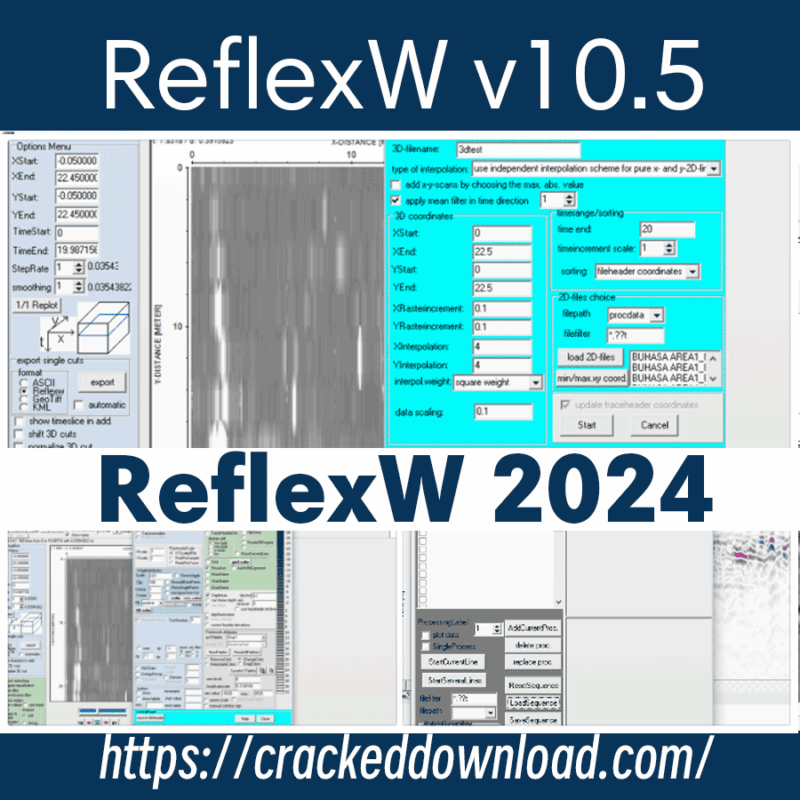
ReflexW v10.5 GPR and seismic data ReflexW 2024
ReflexW 10.0 represents the latest evolution in near-surface geophysical data processing and interpretation software, developed by Sandmeier Geophysical Research in Germany. As one of the world’s most popular geophysical software packages with over 2,000 sold licenses worldwide, ReflexW has established itself as an essential tool for geophysicists, engineers, archaeologists, and environmental scientists working with Ground Penetrating Radar (GPR), seismic, and ultrasound data. Version 10.0, released in April 2022 with continuous updates through version 10.5 in May 2025, brings significant enhancements to an already comprehensive platform that covers the complete range of wave data analysis and interpretation.
ReflexW v10.5 new updates download unlocked version
What is ReflexW?
ReflexW is a Windows-based professional software package designed for the study, processing, and interpretation of near-surface geophysical data. The software handles multiple data types and acquisition geometries, making it an incredibly versatile tool for various geophysical applications. It supports:
- Wave Data Types: Seismic, Ground Penetrating Radar (GPR), and ultrasound data
- Geometry Configurations: Surface reflection and refraction, borehole crosshole and tomography, and combinations of borehole and surface measurements
- Data Dimensions: Both 2D profile data and full 3D volume interpretation
The software’s modular architecture allows users to assemble customized configurations based on their specific needs, making it equally suitable for academic research, commercial consulting, and industrial applications.
ReflexW v10.5 GPR and seismic data ReflexW 2024
Key Application Areas
ReflexW 10.0 excels in several specialized geophysical domains:
Ground Penetrating Radar (GPR) Applications
- Archaeological site investigation
- Utility detection and mapping
- Concrete structure inspection
- Road and pavement assessment
- Environmental contamination studies
- Geological subsurface characterization
Seismic Reflection and Refraction
- Shallow subsurface geological mapping
- Engineering site characterization
- Groundwater exploration
- Bedrock depth determination
- Fault and fracture zone identification
Borehole Geophysics
- Crosshole tomography
- Single-hole velocity logging
- Transmission measurements between boreholes
- Combined surface-to-borehole investigations
Software Architecture: Modular Design
ReflexW’s modular structure consists of three primary modules that can be combined according to user requirements:
1. 2D-Data Analysis Module
The foundation of ReflexW’s capabilities lies in its comprehensive 2D data processing tools:
Data Import Capabilities:
- Support for industry-standard formats (SEGY, SEG2)
- Native compatibility with major GPR systems: GSSI, RAMAC (MALA), PULSE-EKKO, ABEM, OYO, Summit, IDS, UTSI, ImpulseRadar, Proceq
- Custom format integration for non-standard data
- Full GPS support with integrated mapping display (Google Maps, Azure Maps, OpenStreetMap)
Processing Capabilities:
- Interactive single-file processing or automated batch processing
- Comprehensive filter suite (one-channel and multi-channel)
- Static corrections and editing tools
- Advanced deconvolution algorithms
- Migration techniques (Kirchhoff, f-k, Stolt)
- 64-bit processing engine for memory-intensive operations like 3D migration
- Complete documentation of all processing steps
Analysis Tools:
- Interactive velocity analysis using semblance analysis
- Diffraction and first-arrival adaptation for velocity estimation
- Manual, automatic, and semi-automatic picking of arrivals
- ASCII conversion and DXF export of interpreted features
- 3D picking capabilities
CMP Processing:
- Single-shot CMP (Common Midpoint) processing
- Data sorting and display
- NMO (Normal Moveout) analysis
- Stacking procedures
- Interactive velocity analysis for both reflection and refraction data
2. 3D-Data Interpretation Module
The 3D module transforms 2D profiles into comprehensive volumetric datasets:
3D Dataset Generation:
- Easy integration of individual 2D lines
- Support for parallel, crossing, or randomly spaced profiles
- Flexible geometric configurations
Visualization Options:
- X, Y, and Z slice displays
- Manual scalable windows
- Interactive track bar navigation through 3D volumes
- 3D cube display with advanced shading algorithms
- Simultaneous overlay of time slices on mapping platforms
3D-Scan Tool:
- Fast access to rectangular 3D GPR or seismic data
- Optimized for parallel 2D line acquisitions
- Streamlined workflow bypassing traditional import/processing steps
3D Fixed Array Tool:
- Specialized for multichannel data with fixed lateral offsets
- Interactive point access throughout the dataset
- Seamless navigation between profiles and time slices
3D Picking and Interpretation:
- Advanced 3D picking of arrivals and features
- Semi-automatic picking of crooked target objects (e.g., pipes)
- Pick interpolation to 3D surfaces
- Multiple interpolation algorithms (linear, Gaussian)
- Support for multiple layers with different pick codes
3. Modeling and Inversion Module
Advanced forward modeling and inversion capabilities:
Refraction Traveltime Analysis:
- Sophisticated sorting and combining of picked traveltimes
- Finite Difference (FD) based wavefront inversion
- Multiple raytracing methods for synthetic traveltime evaluation
Forward Modeling:
- 2D electromagnetic and seismic wave propagation simulation
- Finite Difference scheme implementation
- Synthetic seismogram generation using the Reflectivity Method
Tomographic Inversion:
- 2D tomography based on SIRT (Simultaneous Iterative Reconstruction Technique)
- Support for both straight and curved ray paths
- 3D tomography for transmission traveltime data
- Applications for refraction and transmission data inversion
Major Enhancements in Version 10.0-10.5
The Version 10 series introduced numerous significant improvements and new features from April 2022 through January 2026:
Full 64-bit Architecture
- Complete 64-bit version for enhanced performance
- Maximum datapoint capacity dramatically increased to 8,192 in all directions for 3D interpretation
- Improved memory handling for large datasets
- Faster processing of memory-intensive operations
Enhanced Data Import Support
New and Updated Import Formats:
- ImpulseRadar Raptor System: Complete support for multiplexed multi-channel data (.ipr, .iph files), various GPS file formats (cor, time/gps, pos, tsp files)
- Proceq Systems: Native SEGY format support for PD80 ultrasound devices and GP8100 GPR systems (6-channel), automated handling of line scan and area scan configurations
- IDS OpenGPR Format: Import of OGPR files with automatic channel demultiplexing and geolocation data integration
- ASCII-Proceq-PD80: Ultrasound device data import with automatic geometry handling
GPS Integration Improvements:
- Support for multiple NMEA sentence types ($GNGGA, $GPGGA, $GNLLQ)
- Enhanced trace-number-based GPS synchronization
- Latency correction for GPS timing offsets
- Smooth coordinate filtering using mean or median algorithms
- Original trace number preservation for improved synchronization
Video Synchronization (New in Version 10.0)
A revolutionary feature allowing synchronization between GPR profiles and video recordings:
- Real-time video playback synchronized with profile display
- Bidirectional synchronization (control video from profile or vice versa)
- Configurable synchronization parameters (start position, step rate)
- Audio muting options
- Integration with field documentation videos for enhanced interpretation
Advanced 3D Visualization and Processing
Timeslice Generation Enhancements:
- Automatic timeslice generation for multiple profiles
- GeoTIFF export with world files for GIS integration
- Envelope processing option
- Interpolation improvements for purely orthogonal line grids
- Full-screen rendering for high-resolution exports
3D Picking Improvements:
- Semi-automatic picking of crooked linear objects with depth variations
- Interactive depth refinement using 3D cube displays
- Pick interpolation to create complete 3D surfaces
- Multiple smoothing modes for pick surfaces
- Code-based layer management
Enhanced 3D Display Options:
- Restriction of display to picked data points
- Separate processing for time slices and orthogonal cuts
- Secondary 3D dataset overlay (e.g., migrated data on time slices)
- Amplitude scaling during import to optimize 16-bit integer representation
Processing Enhancements
New Processing Options:
- Trace Normalization: Restriction to ±1 range with automatic 32-bit float conversion
- 3D Topography Correction: New ASCII matrix format support, Z-coordinate-only update option
- Extract Tool: Coordinate/time range extraction with automatic coordinate shifting
- Correct Picked Phase: Z-value correction based on picked times and velocity
- Split Components: Separate multi-component files into individual component files
- XFlip Profile: Intelligent flipping based on coordinate analysis
Crosscorrelation Improvements:
- Time-cut option for restricted crosscorrelation ranges
- Automatic pick correction using reference file correlation
Running Average Filter:
- Taper width control with definable sample numbers
- Enhanced edge handling
Mapping and GPS Visualization
Complete rewrite of the GPS mapping system with support for multiple map services:
- OpenLayers (no API key required)
- Google Maps
- Bing Maps
- Azure Maps
- TomTom
- Here
- MapBox
Enhanced features include:
- Depth-based color assignment for 3D picks
- Improved coordinate transformation tools
- Batch coordinate transformation for multiple files
- Enhanced background bitmap control
Export Format Enhancements
New Export Formats:
- ImpulseRadar Format: With optional .cor file generation
- ASCII-Geosoft_XYZ: Five-column format with XYZ coordinates, time, and amplitude values
- PULSEEKKO: Ekko_Project format support
Enhanced Export Options:
- Depth/altitude export instead of traveltime (based on specified velocity)
- Header line inclusion in ASCII exports
- Trace time export for SEGY format
- Multiple ASCII column formats with enhanced metadata
User Interface Improvements
Global Settings Enhancements:
- NMEA string customization
- White background option for free data ranges
- Individual comment files per profile option
- EPSG 4647 coordinate system support with automatic UTM zone handling
- Negative latitude support for southern hemisphere data
Display Options:
- Right-axis-only option for distance/depth sections
- Manual display order control for multiple loaded files
- JPG and multi-format image export
- Enhanced bitmap handling for timeslice overlays
Analysis Tools:
- Maximum elevation display in 2D line statistics
- Automatic velocity adjustment for depth-converted data in layer visualization
- Improved correlation file support for automatic pick correction
System Requirements and Compatibility
ReflexW 10.0-10.5 operates on Windows platforms with the following specifications:
Supported Operating Systems:
- Windows 7, 8, 10, and 11 (both 32-bit and 64-bit)
- The software runs natively on Windows only
Recommended Configuration:
- 64-bit Windows for optimal performance with large 3D datasets
- Sufficient RAM for 3D processing (minimum 8GB, 16GB+ recommended)
- Graphics card with OpenGL support for 3D visualization
- Multi-core processor for parallel processing capabilities
Important Notes:
- Project directory should NOT be located under C:Program Files (x86)
- All subdirectories under the project directory must exist
- Settings for “free of distortion” and “FlipYAxis only slices” are stored in Reflexw.ini file
Data Format Compatibility
ReflexW 10.0 boasts exceptional data format compatibility:
Import Formats:
- Industry standards: SEGY, SEG2
- GPR systems: GSSI, RAMAC/MALA, PULSE-EKKO, ABEM, IDS, UTSI, OYO, Summit, ImpulseRadar, Proceq
- Custom ASCII formats with flexible column configurations
- Multiple GPS data formats and synchronization methods
Export Formats:
- SEGY with full metadata
- PULSE-EKKO (including Ekko_Project format)
- ASCII (multiple column configurations)
- DXF for CAD integration
- ImpulseRadar format
- Geosoft XYZ format
- GeoTIFF for GIS integration
Workflow Efficiency Features
Batch Processing
- Automated sequential processing of multiple files
- Processing flow documentation
- Intermediate step storage options
- Script generation for reproducible workflows
Interactive Tools
- Real-time parameter adjustment
- Visual feedback for processing effects
- Undo/redo capabilities for interpretation
- Comment marker system for data annotation
Quality Control
- Comprehensive processing documentation
- Trace header analysis and validation
- Coordinate verification tools
- Automatic data integrity checks
Applications and Use Cases
Archaeological Investigations
- Non-invasive site survey
- Feature detection and mapping
- Depth estimation of buried structures
- Multi-season monitoring
Engineering and Construction
- Utility mapping and location
- Concrete quality assessment
- Foundation investigation
- Void detection beneath pavements
Environmental Studies
- Contamination plume mapping
- Groundwater table determination
- Landfill characterization
- Coastal and marine surveys
Geological Mapping
- Stratigraphy interpretation
- Fault and fracture characterization
- Bedrock topography mapping
- Glacial deposits investigation
Advanced Features for Research
Velocity Analysis
- Multiple velocity analysis techniques
- Semblance analysis for CMP data
- Interactive hyperbola fitting
- Interval velocity calculation
- Velocity model building for migration
Migration Algorithms
- Kirchhoff migration for irregular topography
- F-K migration for stacked sections
- Stolt migration for constant velocity media
- 3D migration for volumetric datasets
- Post-migration enhancement tools
Tomographic Imaging
- Straight-ray tomography for simple models
- Curved-ray tomography for complex velocity structures
- Transmission tomography between boreholes
- Joint inversion of multiple datasets
Professional Support and Documentation
ReflexW 10.0 includes comprehensive support resources:
- Detailed user manual covering all modules
- Tutorial documents for specific applications (GPR, reflection seismics, refraction seismics, borehole geophysics)
- Regular software updates with detailed release notes
- Technical support from Sandmeier Geophysical Research
- Active user community and forum
Conclusion
ReflexW 10.0-10.5 represents a mature, feature-rich platform for near-surface geophysical data processing and interpretation. Its comprehensive toolset, from basic data import through advanced 3D visualization and inversion, makes it suitable for a wide range of applications in geophysics, engineering, archaeology, and environmental science.
The continuous development from version 10.0 (April 2022) through 10.5 (May 2025) demonstrates Sandmeier’s commitment to incorporating user feedback and adapting to new hardware systems entering the market. Key improvements like full 64-bit architecture, video synchronization, enhanced GPS integration, and support for the latest GPR and seismic equipment ensure that ReflexW remains at the forefront of geophysical software solutions.
With its modular design, users can tailor the software to their specific needs, whether focusing on 2D GPR surveys, complex 3D seismic interpretation, or sophisticated borehole tomography. The software’s intuitive interface combined with powerful processing algorithms makes it accessible to students and professionals alike, while its advanced features satisfy the demands of research applications.
For geophysicists seeking a reliable, comprehensive, and continuously evolving platform for near-surface investigations, ReflexW 10.0 stands as one of the industry’s leading solutions, proven by its adoption in over 2,000 installations worldwide.