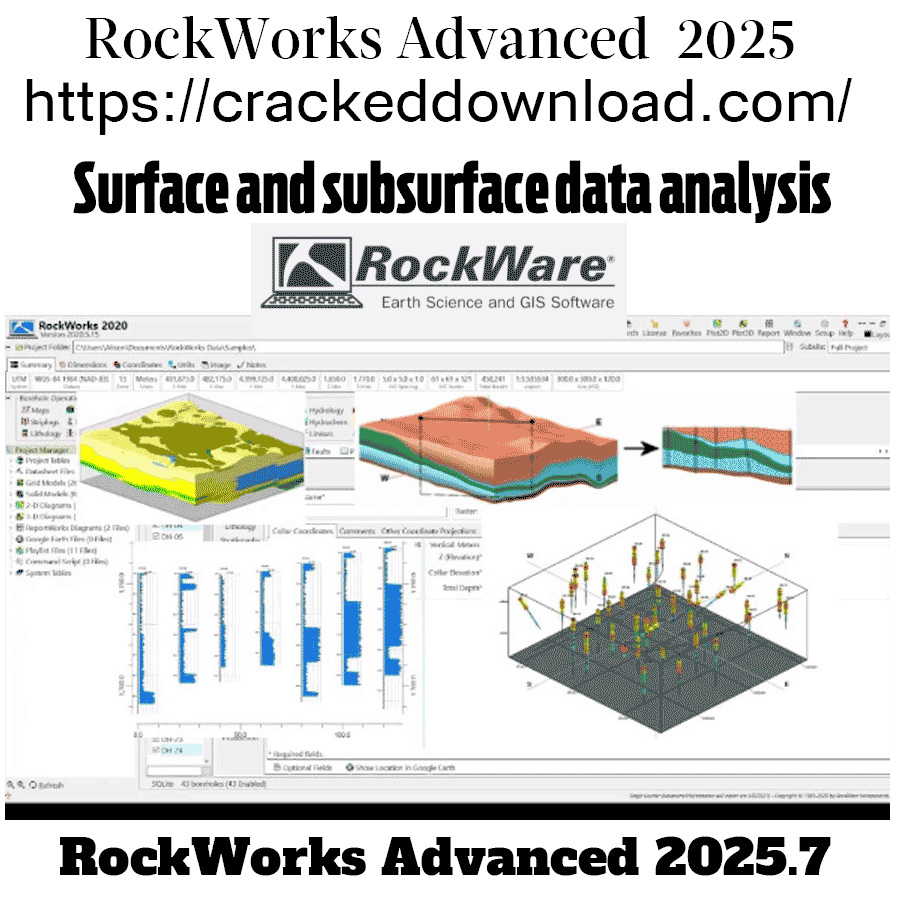
RockWorks Advanced 2025.7.31 Surface and subsurface data analysis crack license download RockWorks Advanced 2025.7
RockWorks Advanced contains all of the tools in the Basic and Standard levels. It also offers professional level features, including automation tools and support of enterprise databases.
What is RockWorks?
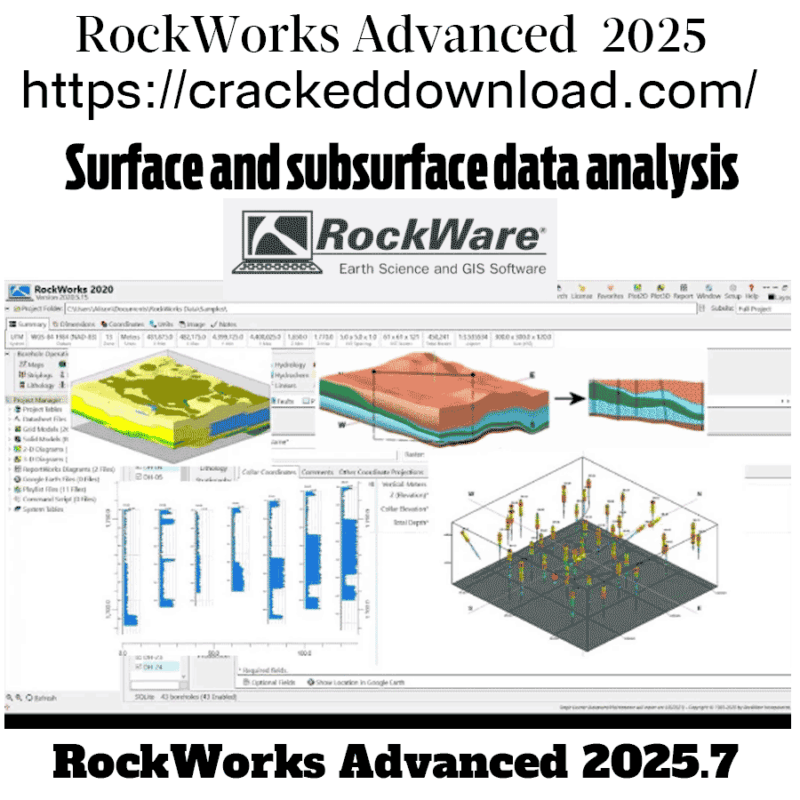
RockWorks is a comprehensive 3D geological modelling and visualization software designed for geologists, hydrologists, and engineers. It enables users to create detailed geological models, visualize subsurface data, and analyze geological structures.
RockWorks is a powerful, integrated software solution designed for geologists, hydrologists, and engineers seeking to explore, analyze, and model subsurface geological data. Developed by Earth Software, this comprehensive 3D geological modelling and visualisation tool enables users to create intricate geological models, visualize complex data sets, and perform in-depth geological analysis.
RockWorks Automation
Playlists – Easy to build, easy to run
Use the Playlist button in any of the application windows to add that program and its current settings to the playlist. With RockWorks Advanced, there is no limit to how many items are included in a single playlist. You can build as many playlists as you like.
If you use RockWorks to create multiple diagrams from your project data, such as sequential cross sections or date-specific maps and models, these playlists are a life-saver! Especially if new data becomes available – just enter the data, run the playlist, and go have lunch; when you return, your maps, models, sections, fences, reports, etc. will be waiting for you.
Command Scripts – Streamline your playlists
Playlists record every possible setting in each program that you add to the list. If you are automating dozens of functions, the lists can get long. Though you don’t ever need to look under the hood of the playlist files, if you are a purist and loved the simplicity of RCL scripts (from earlier versions of RockWorks), then command scripts are for you. Just build a playlist, export it to a command script, and edit/expand it to your heart’s content.
Command scripts can also be run from a command line, for “hands-free” automation. Command scripts are only offered in the RockWorks Advanced feature level.
MS-SQL Server Database Support
The default RockWorks database is a SQLite database. With RockWorks Advanced, you can also set up a connection to an MS-SQL database for company-wide connectivity.
Unlimited Faults
Create / import vertical and 3D faults into RockWorks, with no limit per project. Select the faults to be active and then apply them to your surface modeling, stratigraphy modeling, and/or solid (block) modeling to isolate the modeling within faulted regions. It applies a barrier during modeling such that the data on the other side of the fault (relative to the node currently being estimated) will not influence the node. Simple or complex fault “ribbons” can be used.
Define single faults or multiple, each with two or more X, Y, Z, dip-direction, dip-angle measurements.
Oil and Gas Production Data
Use the Production table in the RockWorks database for storing well production data by date and for generating a variety of graphs in 2D and 3D, and for output to Google Earth.
Import Commercial Land Grids
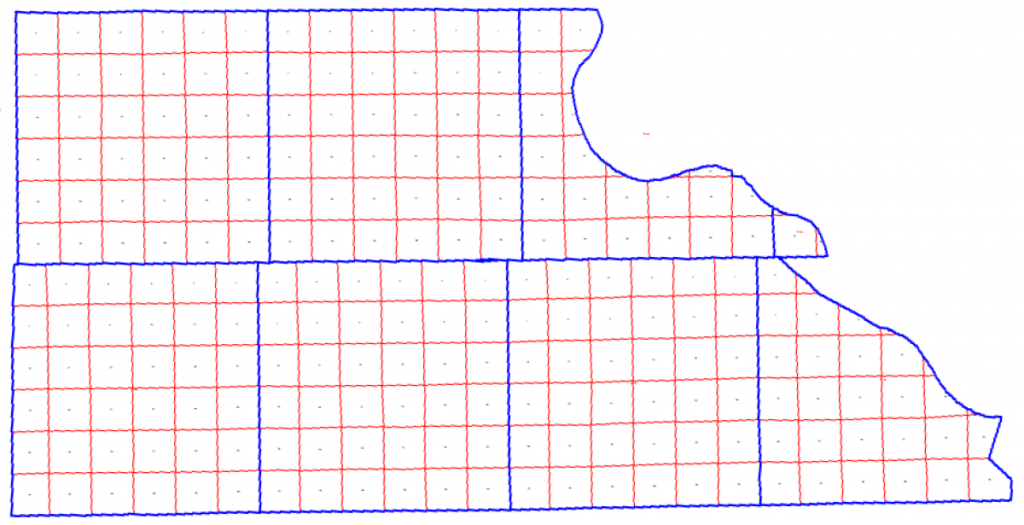
RockWorks comes with a free “LandBase” of US Range-Township-Section locations, gleaned from a variety of public sources. This is available for all levels of the program.
If you’ve purchased a detailed land grid from a commercial source, you can import that data into the LandBase for use in your projects using RockWorks Advanced. RockWorks reads data from IHS (Petroleum Information / Dwights), TMC (Topographic Mapping Company), Tobin / GII/ASCII-31, Tobin / TDRBM II, and White Star.
The Advanced version of RockWorks software includes all the tools of the Standard level, plus SQL Server database support, application automation (scripting) and oil production charts in the Borehole Manager. Unlimited number of items per playlist and unlimited number of faults.
1. The Borehole Manager The beating heart of RockWorks is the Borehole Manager. This section uses a database (usually SQL) with an Excel-like interface that makes it easy to work with. Here you can enter a variety of data, including:
- Lithology: The type of rocks and layers.
- Stratigraphy: The stratigraphy and order of layers.
- Geophysical and geotechnical data: test results and logs.
- Groundwater: Water table and contaminant concentration.
- Orientation: For fractures and faults.
2. Visualization & Modeling Once data is entered, RockWorks offers powerful tools for displaying it:
- Logs: Create 2D and 3D strip logs that graphically display layers and information.
- Maps: Production of various types of contour maps, surface geological maps, and borehole location maps.
- Cross-Sections: Creating geological sections (profiles) between boreholes to understand changes in layers at depth.
- 3D Models: This is one of the most powerful features of the software. RockWorks can create continuous solid models or fence diagrams, which are very useful for showing the spread of contamination, mineral deposits, or geological structures.
3. Analysis and Calculations (Analysis) This software is not just for display, but also performs complex mathematical calculations:
- Volumetrics: Calculating the volume of mineral deposits or contaminated soils.
- Interpolation: Using various algorithms (such as Kriging or Inverse Distance) to estimate data at distances between boreholes.
4. Applications According to the manufacturer’s website, this tool has wide application in the oil and gas, mining (reserve exploration and calculation), environmental (water and soil pollution detection), and civil/geotechnical projects (tooling and dam construction) industries.