

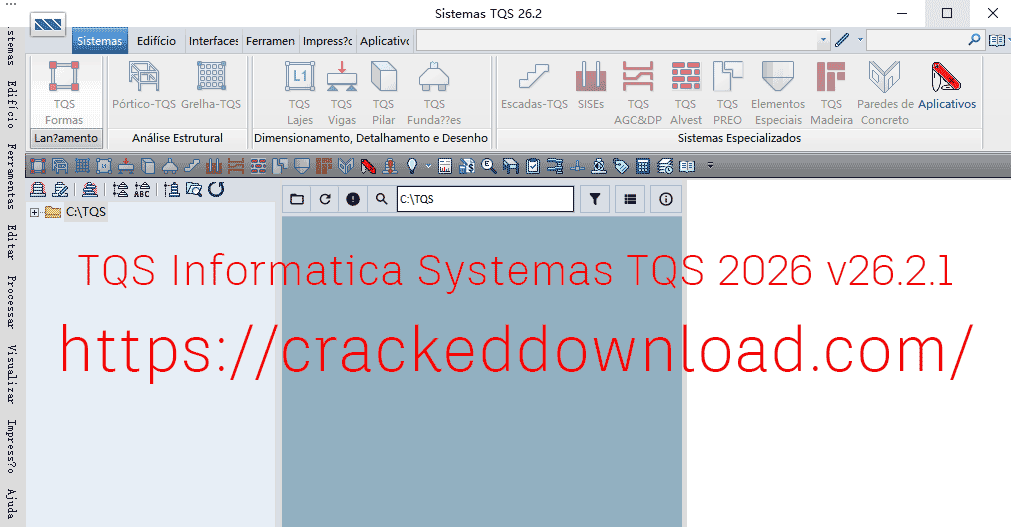
TQS Informatica Systemas TQS 2026 v26.2.1
€0.00
Systemas TQS 2026 CRACK license download TQS Informatica Systemas TQS 2026 v26.2.1, TQS is a professional structural engineering software suite developed by the Brazilian company TQS Informática for the analysis, design, detailing and drawing of building structures — mainly reinforced and prestressed concrete and other structural elements.
Systemas TQS 2026 CRACK license download TQS Informatica Systemas TQS 2026 v26.2.1
TQS is a professional structural engineering software suite developed by the Brazilian company TQS Informática for the analysis, design, detailing and drawing of building structures — mainly reinforced and prestressed concrete and other structural elements.
Integrated structural design platform: TQS isn’t just one tool — it’s a set of software systems that work together to handle the full structural engineering workflow, from model creation and structural analysis through reinforcement detailing and plan generation.
Focused on reinforced concrete and related structures: Many modules support design and checks under Brazilian technical norms (ABNT), but the software is also used internationally in projects where similar codes and workflows apply.
Productivity and BIM-ready: It’s designed to automate repetitive engineering tasks and is compatible with BIM (Building Information Modeling) workflows.
Depending on the specific package or module, TQS can be used for:
- Structural modeling and analysis of buildings — calculating loads, forces, deflections, etc.
- Automatic generation of reinforcement drawings and structural plans.
- Design and detailing of reinforced concrete and prestressed components like slabs, beams, walls, columns.
- Specialized tools — for example for reservoir design, retaining walls, carbon-fiber strengthening, wind loads from tunnel data, and more.
Example Modules in the TQS Ecosystem:
- TQS Full / Student / EPP+ packages: Different versions tailored to project size and user needs (student/educational, small buildings, or full professional designs).
- Reservoir design software: For tank calculations and detailing.
- CONTEN: For design of retaining walls.
- PREF: For carbon fiber structural strengthening.
- HFPIBR: For wind load dynamic analysis integration.
TQS Informatica Systemas TQS 2026 v26.2.1 Overview
TQS Informatica Systemas TQS 2026 v26.2.1
- Structural modeling and analysis of buildings including load calculation, force distribution, and deflection analysis
- Automatic generation of reinforcement drawings, structural plans, and detailed construction documents
- Design and detailing of reinforced concrete and prestressed components such as slabs, beams, columns, walls, and foundations
- Support for Brazilian technical standards (ABNT NBR 6118, NBR 8800:2024, NBR 8681) with international applicability
- BIM interoperability with Revit and IFC formats for coordinated multidisciplinary workflows
- Python scripting API for workflow automation and custom tool development
- Innovative layer-based editing system that preserves manual annotations and modifications when drawings are regenerated
- Supports both 2D and 3D viewports, enabling embedded 3D details within standard DWG drawings
- Reduces rework during project revisions by isolating user edits from automated drawing updates
- Faster processing for shear wall columns with approximately 70% reduction in calculation time
- New grouping functionality for shear wall strips to optimize reinforcement design
- 3D interaction surface visualization for column design verification (N-Mx-My)
- Improved spatial frame and grid visualizer with simultaneous moment display and reduced text clutter
- Dynamic analysis and nonlinear grid capabilities extended to EPP and EPP3 license packages
- Side panel with object tree and properties table for streamlined element management
- Dynamic selection with visual highlighting during mouse movement
- Preview functionality for rotation, mirroring, partial move, and cut commands
- Associative angular dimensions that update automatically during grip editing
- Local coordinate system command for working with rotated windows
- Orthogonal point capture perpendicular to lines
- Precise text sizing calculations for consistent drawing quality
- Support for bold and italic text styles in 3D environment
- PNG image support with options for embedding or referencing
- Enhanced beam reinforcement editor with point-by-point comparison of required versus provided reinforcement
- Interactive grip-based editing for bar placement, grouping, and modification
- Color-gradient diagrams for intuitive visualization of bending and shear forces
- Verification that accounts for minimum moments and minimum reinforcement ratios
- Customizable stirrup diameters for sections with torsion
- Improved opening reinforcement calculation with optimized suspension bar design
- Minimum height verification for single-pile pile caps according to technical references
- Fusco Method A calculation using actual starter bar reinforcement from columns
- Enhanced pile cap reports and automated reinforcement editing with spacing adjustment
- Generic pile cap modeling with enlarged column area considered in strut verification
- Automatic load plan generation at column bases for specific conditions like walls or rafts
- New unidirectional joist slab type with adjustable self-weight parameters
- Copy, paste, and mirror commands for grout placement across floors
- Continuous dimensioning command for rapid annotation
- Fast visualization mode for improved performance on large buildings
- Improved block distribution algorithm to avoid overlaps with imposed blocks
- 3D resistant curve visualization for masonry wall verification
- Automated verification of user-defined reinforcement in concrete walls with visual feedback
- Serviceability limit state verification for crack opening (ELS-W) enabling partial prestressing design
- Enhanced cable layout visualization with launch point indicators
- Updated maximum compression limits for ELS-D and ELS-F per NBR 6118:2023 revision
- 3D editor for prestressed slabs with color-gradient cable diagrams and new anchorage detail blocks
- Full incorporation of ABNT NBR 8800:2024 revisions affecting compression, shear, bending, and composite column calculations
- New composite column types in Structural Modeler: rectangular filled and encased, circular filled
- Mixed modeling of steel and reinforced concrete elements within the same project
- Automated quantity takeoff tables for composite elements
- Shared coordinate system workflow for seamless Revit integration with automatic model transformation
- Import of penetration markings from BIM models with automatic hole creation and reinforcement calculation following Abrasip IFC standards
- Updated TQS plugin compatible with Revit 2026 and TQS v25
- IFC import enhancements including transparency toggle, custom building titles, and category-based point count for memory optimization
- Interactive Modeler control for real-time element manipulation with undo/redo support
- 3D Models module for programmatic creation of prisms, paths, and generic solids
- Automated Sheets module for reading, manipulating, and saving CPL layout files
- Reinforcement Drawings module for automated status checking, transformation, and annotation of rebar details
- AI-assisted code generation support using the TQS Python API documentation
- Redesigned 3D Borehole Editor with unified interface for soil data entry
- Simultaneous visualization of multiple boreholes in comparative and perspective modes
- Color-coded soil layer representation by depth for enhanced interpretation
- Three-dimensional visualization with layer-specific coloring
- Embedded carbon index estimation in material cost reports with configurable parameters
- Direct integration with SIDAC/BIP systems for sustainability analysis
- Comprehensive reporting with geometry, formulations, verifications, and results in standardized format
- Perpetual license for version 26 with indefinite use and optional future version upgrades
- Subscription model with monthly payments including access to future versions and technical support
- Tiered packages including Full, EPP, EPP3, Student, and specialized modules for masonry, precast, and geotechnics
- Operating System: Windows 10 or 11 64-bit
- Processor: Multi-core CPU recommended for analysis tasks
- RAM: Minimum 8 GB, 16 GB or more recommended for large models
- Graphics: OpenGL or Direct3D compatible GPU with updated drivers
- Storage: SSD recommended for improved performance
- Disk Space: Approximately 1 GB for installation plus additional space for project files
- Technical support provided by structural engineering specialists
- Online courses and specialized training programs
- TQS Community forum, TQS Docs knowledge base, and TQSNews publication
- Regular software updates with significant enhancements approximately every 18 months
Related products

Geology


Geology

Biomedical


Mining Industry


Uncategorized

Uncategorized
Uncategorized

Geology
Simulation

Mathematical

Uncategorized
Uncategorized
Uncategorized


Uncategorized

Uncategorized

Science Research


Mathematical

scientific software


Geology

Uncategorized

Uncategorized


unlimited find


Science Research


chemistry software
Uncategorized
Uncategorized


Mathematical


unlimited find

Science Research
engineering softwares
Uncategorized
Uncategorized

Cad/Cam
Uncategorized

engineering softwares

Uncategorized
unlimited find


Uncategorized

Uncategorized


Science Research
Uncategorized
Cad/Cam

Science Research


Uncategorized
Uncategorized
