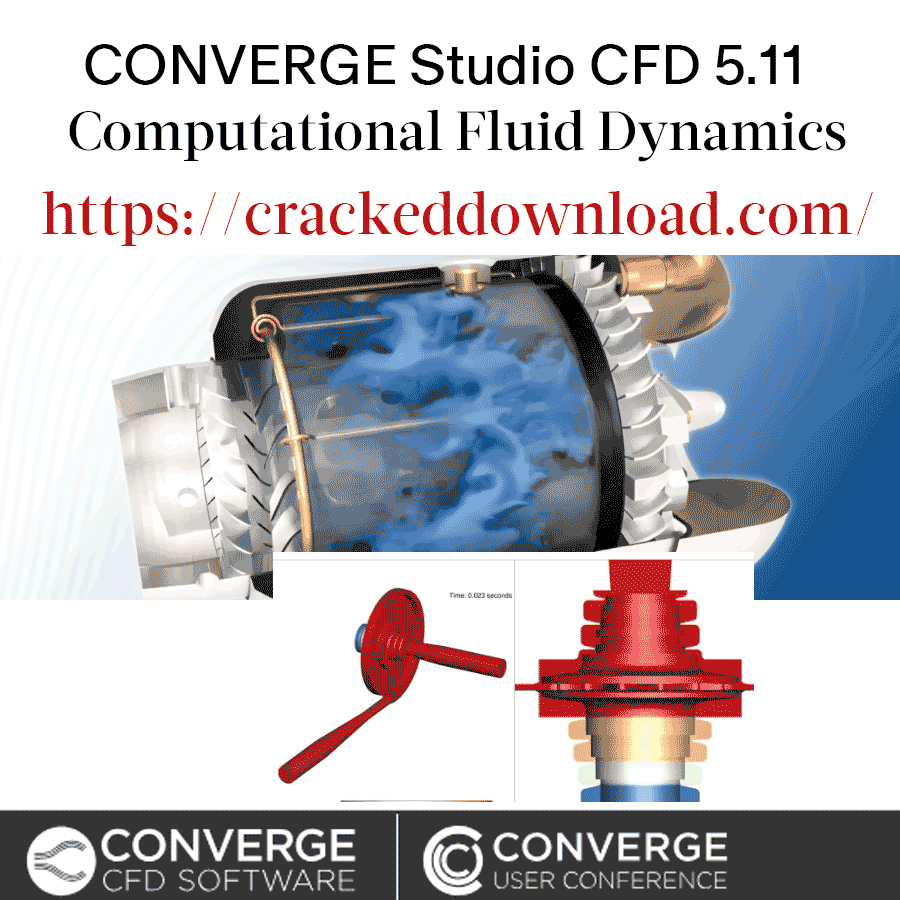
CONVERGE Studio CFD Bundle 5.1.1 Computational Fluid Dynamics
€0.00
CONVERGE Studio 5.1 crack license CONVERGE Studio CFD Bundle 5.1.1 Computational Fluid Dynamics
CONVERGE Studio CFD Bundle 5.1.1 Computational Fluid Dynamics is a computational fluid dynamics (CFD) software. CONVERGE Studio uses an innovative method for generating meshes at runtime, completely eliminating the need for the user to spend time creating meshes. Because of this technology,
CONVERGE Studio 5.1 crack license CONVERGE Studio CFD Bundle 5.1.1 Computational Fluid Dynamics
CONVERGE Studio CFD Bundle 5.1.1 Computational Fluid Dynamics is a computational fluid dynamics (CFD) software. CONVERGE Studio uses an innovative method for generating meshes at runtime, completely eliminating the need for the user to spend time creating meshes. Because of this technology,
CONVERGE can handle moving boundaries completely automatically, without the common problems of deformed meshes that are usually seen in moving boundaries. The software uses perfectly perpendicular and regular cells, which increases the accuracy of calculations and simplifies numerical solutions. It also preserves the true shape of the geometry independent of the size and accuracy of the mesh.
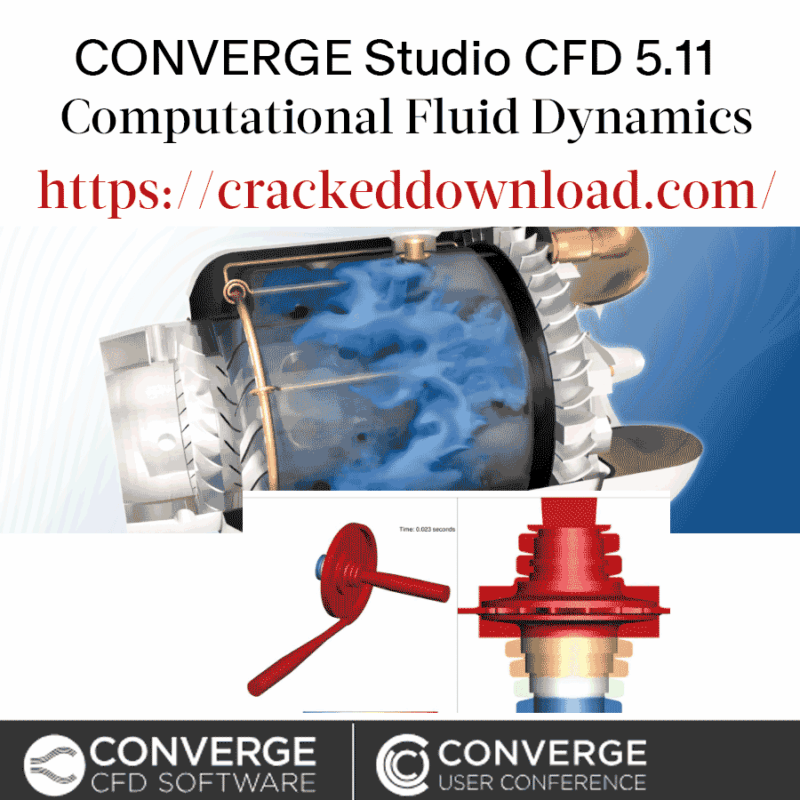
CONVERGE’s Adaptive Mesh Refinement (AMR) technology is a fully customizable method that automatically refines the mesh at runtime, only in the areas where it is needed. You no longer have to guess in advance where you need to have a more accurate mesh. By using more mesh in important areas and less mesh in unnecessary areas, AMR both increases computational accuracy and reduces simulation execution time
CONVERGE Studio vs. CONVERGE CFD Solver
The primary difference is:
- CONVERGE Studio is the graphical pre-/post-processing environment
- CONVERGE CFD solver is the numerical engine that actually runs the simulation
1. Purpose
CONVERGE Studio
- Used to set up simulations
- Lets you define geometry, regions, boundaries, physics models, initial conditions, outputs, and run settings
- Also used to visualize and analyze results
CONVERGE CFD solver
- Performs the actual CFD calculations
- Solves the governing equations for fluid flow, heat transfer, combustion, sprays, turbulence, chemistry, moving boundaries, etc.
- Produces the simulation output files that Studio or other tools can read
2. Role in the workflow
Typical workflow:
- Build/import case in CONVERGE Studio
- Export/generate input files
- Run the CONVERGE solver
- Open results back in Studio for post-processing
So Studio is the interface/workbench, while the solver is the compute backend.
3. User interaction
Studio
- GUI-based
- Easier for case creation, checking settings, and plotting results
- Reduces manual editing of input files
Solver
- Usually run from the command line, scripts, or HPC job schedulers
- More relevant for batch runs, large parametric studies, and cluster computing
4. Computational function
Studio
- Does not primarily do the heavy CFD computation
- Helps prepare the case and inspect outputs
Solver
- Consumes most of the CPU/GPU/cluster resources
- Handles meshing during runtime, time stepping, discretization, convergence, and model coupling
A notable CONVERGE concept is that the solver uses autonomous meshing / adaptive Cartesian mesh techniques during the simulation, which is a core part of the actual computation.
5. File and data responsibilities
Studio
- Creates/edits case input structure
- Organizes setup files
- Reads result files for visualization
Solver
- Reads the prepared input files
- Writes logs, restart files, field data, and other outputs
6. Licensing/use distinction
In many organizations:
- Studio licenses may be used by engineers preparing and reviewing cases
- Solver licenses/tokens are tied to actually executing simulations, often especially on servers or clusters
Exact licensing depends on the vendor agreement, but conceptually they are often treated differently.
Simple analogy
Think of it like this:
- CONVERGE Studio = the CAD-style control panel + viewer
- CONVERGE CFD solver = the engine doing the physics calculations
Or:
- Studio is where you tell the software what problem to solve
- Solver is what solves it
In one sentence
CONVERGE Studio is for setup and post-processing; CONVERGE CFD solver is for computation and simulation execution.
If you want, I can also explain:
- how CONVERGE Studio, CONVERGE CFD, and CONVERGE Studio CFD Bundle relate to each other, or
- what is typically included in version 5.1.1.
CONVERGE is a leading computational fluid dynamics (CFD) software package with an emphasis on accuracy, efficiency, and innovation. With truly autonomous meshing, state-of-the-art physical models, and the ability to easily accommodate complex moving geometries, CONVERGE is fully equipped to help you solve the hard problems.
Innovative Meshing
CONVERGE features fully autonomous meshing, which eliminates all user meshing time from the simulation process. In addition, CONVERGE’s novel cut-cell approach perfectly represents your geometry—no matter how complex—and easily accommodates moving boundaries. This approach avoids the numerical viscosity generated by deforming meshes and offers accurate results without intensive hands-on setup. Moreover, Adaptive Mesh Refinement allows you to efficiently achieve the best solution possible for a given computational expense by adding cells when and where they are needed to resolve key flow phenomena.
Capture Essential Physical Processes
Going beyond a visually appealing simulation to obtaining useful, realistic results requires accurate physical modeling. CONVERGE contains an extensive suite of well-validated physical models for simulating everything from fluid-structure interaction and conjugate heat transfer to spray and combustion. In addition, CONVERGE includes the SAGE detailed chemistry solver, which is fully coupled with the flow solver for maximum accuracy and efficiency. If you’re interested in implementing a custom model, you can easily do so through user defined functions (UDFs) to customize CONVERGE to meet your needs.
Accelerate R&D
CONVERGE is designed to simplify and expedite the research and design process for an expansive range of applications, from gas turbine engines to mechanical heart valves. With CONVERGE, you can perform a comprehensive system analysis and optimization to find the best design before building an expensive physical prototype. Since 3D CFD simulations can require long runtimes, CONVERGE enables highly parallel simulations on many processors and demonstrates excellent scaling even on thousands of cores. Taking advantage of these capabilities can drastically reduce time-to-solution for your simulations. Overall, incorporating CONVERGE into your R&D workflow can reduce costs across the board and enable you to bring your product to market sooner.
What’s New in CONVERGE 5?
CONVERGE 5, the latest major release of our CFD software, includes many exciting new features and enhancements that expand both the capability and usability of the code across industries and applications.
Rockets
The conditions inside of a liquid rocket combustor span an immense range of pressures and temperatures during operation. Combustion temperatures can reach 200 times the temperatures of stored propellant, and pressures in the injector and combustion chamber are orders of magnitude greater than at the nozzle exit. In addition, phase change is omnipresent, with opportunities for vaporization as the liquid fuel or oxidizer cools the engine on its path to the combustion chamber, cavitation in the turbopumps or injectors, solidification as ice forms near the cold walls, and condensation at the nozzle outlet. These changes in phase can occur even before the combustion reactions convert the fuel and oxidizer into gas-phase products to propel the device. To accurately simulate liquid rocket combustors, you need to be able to capture the phase transitions and associated property changes under these extreme conditions.
Related products


Science Research


unlimited find
engineering softwares

Science Research

Simulation

Uncategorized
Cad/Cam

Uncategorized
Science Research
Uncategorized


Geology


Mathematical

Geology

Mining Industry

Dental Software


Uncategorized

Uncategorized
Simulation

Cad/Cam
Uncategorized

Mining Industry


chemistry software


Uncategorized
Uncategorized
Uncategorized

Geology


Oil and Gas


Uncategorized


Uncategorized


Mathematical
Uncategorized
unlimited find


Science Research


Uncategorized

Uncategorized
Simulation


Science Research
Uncategorized

Uncategorized

Uncategorized

Uncategorized
Uncategorized

scientific software

unlimited find