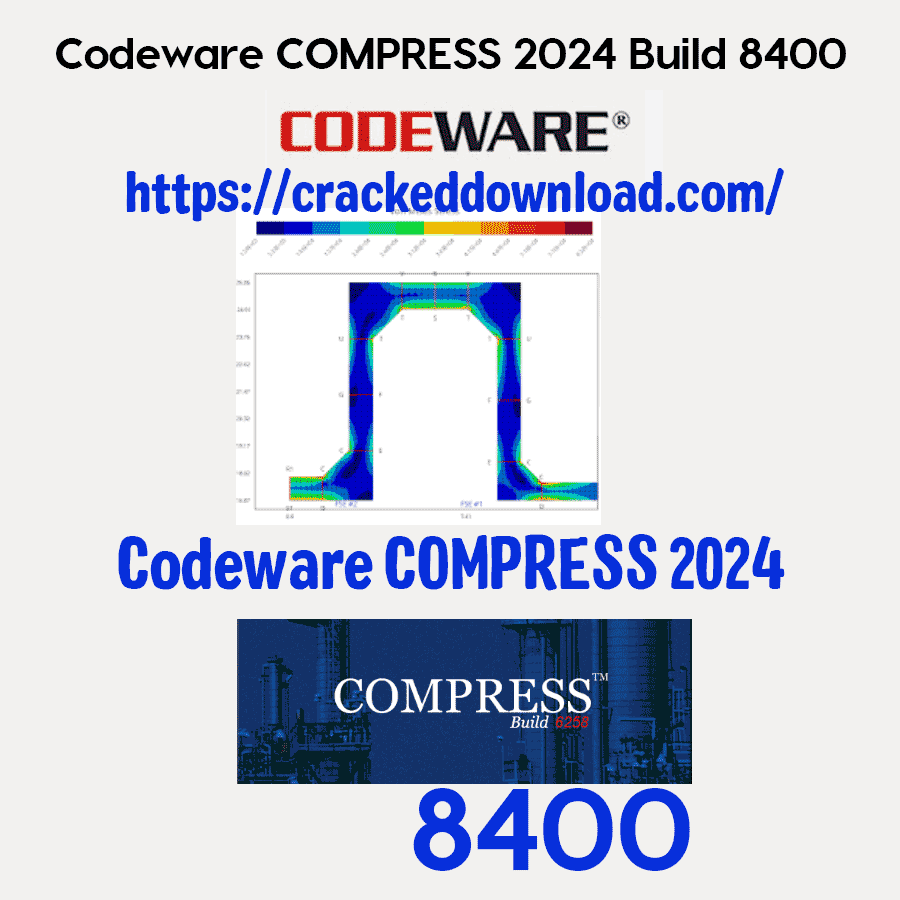
Codeware COMPRESS 2024 Build 8400
€0.00
Codeware COMPRESS 2024 Build 8400 crack license download,
Codeware COMPRESS 2024 Build 8400
Codeware COMPRESS 2024 Build 8400 is a pivotal release for the industry-standard pressure vessel and heat exchanger design software. Its most significant milestone is full compliance with the 2023 Edition of the ASME Section VIII Code.
Codeware COMPRESS 2024 Build 8400 crack license download,
Codeware COMPRESS 2024 Build 8400 crack torrent link
Codeware COMPRESS 2024 Build 8400 is a pivotal release for the industry-standard pressure vessel and heat exchanger design software. Its most significant milestone is full compliance with the 2023 Edition of the ASME Section VIII Code.
Codeware COMPRESS 2024 Build 8400 crack Key New Features and Enhancements
-
2023 ASME VIII Code Update: Build 8400 and higher are required for designs adhering to the 2023 ASME Boiler and Pressure Vessel Code (BPVC).
-
Finite Element Analysis (FEA): This build introduced FEA specifically for TEMA Expansion Joints, allowing for more precise stress analysis in heat exchangers.
-
Lifting Lug Flexibility: Lugs can now be attached to a wider range of subassemblies, including welded/bolted covers, flanges, and tubesheets.
-
ASME B16.11-2021 Integration: Updated dimensions and weld ring values for couplets to match the 2021 standard.
-
3D View Improvements: Added the “Zoom on mouse cursor” feature, making navigation of complex models significantly more intuitive.
-
Revised History Dialog: A more user-friendly interface for tracking design iterations, including the ability to mix numeric and letter-based revision increments.
Here is the English translation of the content you provided regarding Codeware COMPRESS:
Codeware COMPRESS 2024 Build 8400 crack
Codeware COMPRESS Software
Codeware COMPRESS is a powerful software for the design and analysis of pressure vessels using ASME Section VIII Division 1 and Division 2 design standards. This software is primarily used for the design and analysis of pressure vessels in industries such as petrochemicals, oil and gas, and other pressure-related sectors. It is developed and published by Codeware Inc.
COMPRESS provides a functional graphical environment and a variety of capabilities for pressure vessel design and analysis. Using this software, you can easily create and edit pressure vessel designs. Various features and facilities are included to help you engage in the precise and optimal design of pressure vessels.
Key Features of Codeware COMPRESS
-
User-Friendly Graphical Interface: An easy-to-understand environment that simplifies the design, analysis, and documentation of pressure vessels.
-
Powerful Modeling Tools: Robust capabilities to create and edit pressure vessels at various scales in accordance with relevant industrial standards.
-
Comprehensive Analytical Tools: Provides extensive tools for calculating load-bearing capacity, corrosion analysis, piping design, and more.
-
External Integration: The ability to connect to external databases and exchange data with other management systems (such as PV Elite and CAESAR II).
-
Standardized Reporting: The ability to generate comprehensive and standardized reports for pressure vessels.
-
Multi-Standard Support: COMPRESS supports recognized international standards including ASME VIII Div. 1 & 2, EN 13445, PD 5500, and API 650.
Choosing between Codeware COMPRESS and Hexagon PV Elite—or deciding between ASME Section VIII Division 1 and Division 2—depends heavily on your specific project goals, such as material savings versus engineering time.
1. COMPRESS vs. PV Elite: Which is better?
PV Elite v27 PVElite 2025 PV Elite Pressure Vessel Design
Both are industry leaders, but they excel in different areas of the workflow.
|
Feature |
Codeware COMPRESS | Hexagon PV Elite |
| Best For | Fabricators & Manufacturers. It focuses on “how to build it” with detailed drawings and reports. | Engineering Firms (EPCs). It focuses on “how it performs” with deep analytical capabilities. |
| User Interface | Highly intuitive, 3D-centric, and “guardrail” heavy (warns you of errors as you go). | More technical, spreadsheet-style inputs; requires more manual checking but offers more control. |
| Heat Exchangers | Excellent for TEMA and ASME UHX; very visual. | Industry standard for complex exchangers; handles multi-component assemblies very well. |
| Reporting | Extremely detailed; generates “manual-style” calculations that are easy for inspectors to verify. | Clean, concise reports; widely accepted by major oil and gas owners globally. |
| 3D Integration | Best-in-class integration with SolidWorks and Autodesk Inventor. | Strong integration with CADWorx and other Hexagon products. |
2. ASME Section VIII: Division 1 vs. Division 2
The shift from Division 1 to Division 2 is a shift from Design-by-Rule to Design-by-Analysis.
Division 1 (The Workhorse)
-
Methodology: Uses simple algebraic formulas (Design-by-Rule).
-
Safety Factor: Higher (typically 3.5), leading to thicker walls.
-
When to use: Standard vessels, lower pressures, or when you want to minimize engineering time/costs. It is simpler to certify and requires less documentation.
Division 2 (The Modern Choice)
-
Methodology: Uses Finite Element Analysis (FEA) and Von Mises stress theory (Design-by-Analysis).
-
Classes: * Class 1: A newer “middle ground” with a safety factor of 3.0.
-
Class 2: High-performance vessels with a safety factor of 2.4 (thinnest walls).
-
-
When to use: * Cost Savings: If the vessel is large/thick (e.g., >200 gallons or high pressure), the material savings often outweigh the higher engineering cost.
-
Cyclic Service: If the vessel undergoes frequent pressure/temperature changes (Fatigue Analysis is required).
-
High Pressure: Essential for vessels operating above 3,000 psig.
-
Comparison Summary: Which should you choose?
-
Choose COMPRESS + Div 1 if you are a fabrication shop looking to quickly produce safe, standard vessels with automatic drawing generation.
-
Choose PV Elite + Div 2 if you are an engineering firm designing high-spec equipment for global energy projects where weight reduction is critical.
Related products


Mathematical

Uncategorized

Uncategorized

Science Research

Simulation


unlimited find
unlimited find

engineering softwares
Uncategorized

Science Research

Mathematical
Uncategorized


Uncategorized

Geology
Uncategorized
Uncategorized

Science Research


unlimited find

Mining Industry

Uncategorized

Mining Industry

unlimited find


Uncategorized


engineering softwares

engineering softwares


chemistry software
Uncategorized
Uncategorized
Uncategorized

Geology


Uncategorized

Uncategorized

Simulation

Biomedical


Science Research

scientific software


Mathematical

Science Research

Dental Software

Geology
Simulation


unlimited find
Uncategorized
Uncategorized